Speaker Audio Simulation Software
Products and designs involving acoustic phenomena can be modeled to study and predict factors like sound quality and noise reduction performance. The Acoustics Module is an add-on to the that provides tools for modeling acoustics and vibrations for applications such as speakers, mobile devices, microphones, mufflers, sensors, sonar, and flow meters.

You can use the specialized features to visualize acoustic fields and build virtual prototypes of devices or components.For more detailed studies, acoustics can be coupled with other physical effects, including structural mechanics, piezoelectricity, and fluid flow. The COMSOL ® software contains multiphysics couplings to enable you to evaluate the performance of a product or design in an environment that is as close as possible to the real world.The Acoustics Module also includes many specialized formulations and material models that can be used for dedicated application areas, like thermoviscous acoustics used in miniature transducers and mobile devices or Biot's equations for modeling poroelastic waves. The multiphysics environment is extended further with several dedicated numerical methods, including the finite element method (FEM), boundary element method (BEM), ray tracing, and discontinuous Galerkin finite element method (dG-FEM). To model pressure acoustics effects, such as the scattering, diffraction, emission, radiation, and transmission of sound, you can use the pressure acoustics interfaces. Problems are modeled in the frequency domain via the Helmholtz equation or in the time domain via the classical scalar wave equation.There are many options to account for boundaries in acoustics models. For instance, you can add a boundary condition for a wall or an impedance condition for a porous layer.
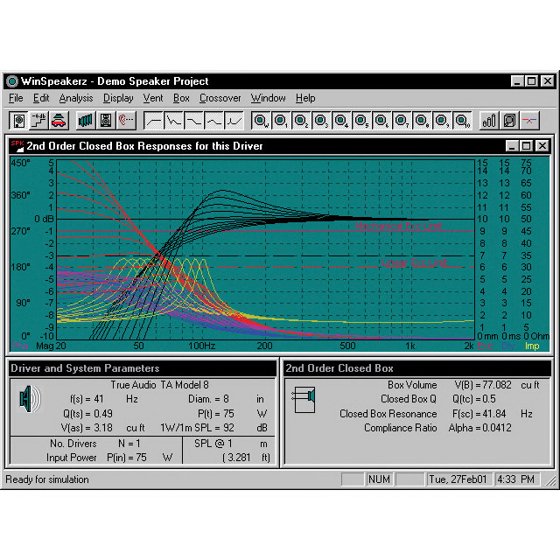
With the introduction of the IBM PC and DOS operating system in the early 1980s, Thiele-Small (T-S) simulation software for enclosure design became a must-have for speaker system designers (e.g., autosound installers, pro-sound, commercial speaker, and stereo and home-theater speaker designers). The Acoustics Module is an add-on to the COMSOL Multiphysics ® software that provides tools for modeling acoustics and vibrations for applications such as speakers, mobile devices, microphones, mufflers, sensors, sonar, and flow meters. You can use the specialized features to visualize acoustic fields and build virtual prototypes of devices.
You can use ports to excite or absorb acoustic waves at the inlet and outlet of waveguides using multimode expansion. Sources like prescribed acceleration, velocity, displacement, or pressure can be applied on exterior or interior boundaries. Further, you are able to use radiation or Floquet periodic boundary conditions to model open or periodic boundaries.You can also compute and visualize the exterior field in a model with open boundaries including everything from the near field to the far field. The radiation pattern or spatial response can be visualized with polar plots or a directivity plot. Using the Acoustics Module, you can simulate the interaction between acoustics and structural mechanics within a product or design. Predefined interfaces enable you to study vibroacoustics and automatically couple fluid and structural domains.
The Solid Mechanics interface uses a full structural dynamics formulation that accounts for the effects of shear waves and pressure waves in solids and analyzes elastic waves. A dedicated Poroelastic Waves interface is used to model the coupled propagation of elastic and pressure waves in porous materials solving Biot's equations.Multiphysics couplings can easily couple porous domains, solid domains, piezoelectric materials, and fluid domains to model the behavior of real-life devices. Structures can be prestressed and their harmonic behavior can be analyzed while fully coupled to acoustics. Application areas. The geometrical acoustics capabilities of the COMSOL ® software can be used to evaluate high-frequency systems where the acoustic wavelength is smaller than the characteristic geometric features. There are two interfaces for computing geometric acoustics available with the Acoustics Module: Ray Acoustics and Acoustic Diffusion Equation.With the Ray Acoustics interface, you can compute the trajectories, phase, and intensity of acoustic rays.
Additionally, you can calculate impulse responses and energy decay curves with a specialized Receiver data set and other postprocessing tools. The rays can propagate in graded media, which is necessary in underwater acoustics applications. For simulating ray acoustics in both air and water, specialized atmosphere and ocean attenuation material models are available that are important for wave propagation over large distances and at high frequencies.With the Acoustic Diffusion Equation interface, you can determine the sound pressure level distribution in coupled rooms and the reverberation times at different locations. The acoustics are modeled in a simplified way using a diffusion equation for the acoustic energy density. This interface is well suited for quick analyses inside buildings and other large structures. You can efficiently solve computational aeroacoustics (CAA) problems with a decoupled two-step approach in the Acoustics Module.
First, you find the background mean flow using tools from the or a user-defined flow profile; then, you solve the acoustic propagation problem. This is also sometimes referred to as convected acoustics or flow-borne noise simulations.Predefined interfaces can compute acoustic variations in pressure, density, velocity, and temperature in the presence of any stationary isothermal or nonisothermal background mean flow.There are stabilized finite element formulations for:. Linearized Navier-Stokes. Linearized Euler. Linearized potential flowThe formulations readily account for the fluid-borne sound, convection, damping, reflection, and diffraction of acoustic waves by the flow. There is also functionality for FSI analyses in the frequency domain with predefined couplings to elastic structures.
Application areas:. Jet engine noise. Mufflers including background flow. Flow meters.
Coriolis flow meters. Analysis of liners and perforates in the presence of flow. Combustion instabilities. For an accurate analysis of acoustic propagation in geometries with small dimensions, you need to account for losses associated with viscosity and thermal conduction; particularly, the losses in the viscous and thermal boundary layers. These effects are solved in full and automatically included within the equations solved by the thermoviscous acoustics interfaces.These interfaces are well suited for vibroacoustics modeling in miniature electroacoustic transducers like microphones, mobile devices, hearing aids, and MEMS devices.
For detailed transducer modeling, you can use the built-in multiphysics couplings between structures and thermoviscous acoustic domains.The interface accounts for additional effects, including the full transitional behavior from adiabatic to isothermal at very low frequencies. There is also a dedicated interface for computing and identifying propagating and nonpropagating modes in narrow waveguides and ducts. Application areas:. Mobile devices. Miniature transducers.
MEMS. Hearing aids. Microphones.
Perforates and perforated plates. The Ultrasound interfaces are used to compute the transient propagation of acoustic waves over large distances, relative to the wavelengths. Acoustic disturbances with frequencies that are not audible for humans are classified as ultrasound. This implies that ultrasonic waves have a short wavelength.The Convected Wave Equation, Time Explicit interface is used to solve large transient linear acoustic problems containing many wavelengths in a stationary background flow.
It is suited for time-dependent simulations with arbitrary time-dependent sources and fields.The interface is based on the dG method and uses a time-explicit solver, which is a very memory-lean method. Application areas:. Ultrasound flow meters.
Ultrasound sensors with time of flight. Transient propagation of sound signals in the presence of flow. Intuitive Modeling WorkflowThe COMSOL ® software provides a consistent and easy-to-follow workflow, whether you are working only with COMSOL Multiphysics ® and the Acoustics Module or combining additional products from. The modeling steps are straightforward and include:.
Ease 4.4 Download
Defining the geometry. Selecting materials. Selecting a suitable physics interface. Defining the boundaries and initial conditions. Automatically creating the finite element mesh. Solving the physics. Visualizing the results.
Numerical Methods and StudiesThe solvers and methods used to complete analyses in the COMSOL ® software are both flexible and efficient. Problems encountered in acoustics span many decades of frequencies. The computational complexity can be highly dependent on the acoustic formulation. As a consequence, no single method or numerical technique is suitable for all acoustic problems.The Acoustics Module includes four different computational methods: FEM, BEM, ray tracing, and dG-FEM, as described below. Different study types complement the different numerical formulations in order to allow for all necessary analysis types. This includes, but is not restricted to, frequency domain, eigenfrequency and eigenmodes, and transient studies.
Dedicated iterative methods make it possible to model large multiphysics and multimethod problems involving many million degrees of freedom. Acoustic LossesIt is simple to include acoustic losses in a model. This enables you to model, for example, porous and fibrous materials by solving Biot's theory via the Poroelastic Waves interface. Alternatively, porous domains can be modeled with an equivalent fluid approach using the Poroacoustics material model in pressure acoustics. Poroacoustics include, for example, the Delany-Bazley, Miki, and Johnson-Champoux-Allard models. Losses and attenuation can also be included as user-defined expressions, analytical models, or data based on measurements.Detailed models including thermal and viscous losses can be set up with the Thermoviscous Acoustics interface. This includes all effects associated with the acoustic viscous and/or thermal boundary layers.
To model their damping, you can couple to vibrating structures by simply using the built-in multiphysics couplings. In waveguides or structures of constant cross section, a simplified approach based on homogenization of the boundary layer losses can be achieved using the Narrow Region Acoustics material model in pressure acoustics problems.The attenuation of acoustic signals as they travel through a moving fluid including high flow gradients, temperature gradients, or turbulence can be modeled in detail with the Linearized Navier-Stokes interfaces. The background flow can be calculated using the capabilities of the CFD Module.
Electroacoustics CapabilitiesWhen modeling transducers of all sorts, the capabilities included in the Acoustics Module are readily combined with functionality from the or the to create fully coupled multiphysics FEM models. This includes detailed modeling of magnets and voice coils in loudspeaker drivers or the electrostatic forces in condenser microphones. In electro-mechanical-acoustic transducer systems, it is easy to use lumped circuit models to simplify the electric and mechanical components. Both approaches are solved with a fully two-way coupling. In miniature transducer systems, like mobile devices, condenser microphones, and hearing aid receivers, the important damping due to the thermoviscous boundary layer losses is included in detail using the Thermoviscous Acoustics interfaces and the multiphysics couplings to other physics like vibrating structures.Applications include, but are not limited to:. Fully coupled loudspeaker modeling. Loudspeaker drivers.
Coupling lumped circuit models to FEM domains. Use of the AC/DC Module to optimize magnetic components. Microphones. MEMS microphones. Hearing aids. Mobile devices. Open Domains and Radiation ProblemsIn the study of acoustics, it is common to simulate open problems where acoustic waves should be able to radiate without any reflections.
This includes modeling the spatial sensitivity of transducers or scattering problems in sonar applications. Modeling nonreflecting boundaries is achieved using different techniques and features.
Impedance conditions and radiation conditions exist for simple problems. How to fix taskbar not hiding. Equation-Based Modeling: Modify the Governing Equations or Set Up User-Defined Multiphysics CouplingsFor full control over simulations, you can use equation-based modeling to modify the governing equations and boundary conditions directly within the software, further customizing models for your own analyses. For example, you can model physics that are not predefined in the Acoustics Module or set up new multiphysics couplings. This includes modifying material models to model nonlinear effects by adding or modifying constitutive relations.
Coupling physics in a nonstandard way is also possible. Examples of this include coupling acoustics and CFD to model acoustic streaming or the nonlinear effects of vortex shedding generated by acoustic waves.As an added benefit, by using an equation-based modeling approach and eliminating the need for fundamental coding, you can greatly increase the flexibility in what you can model and reduce the time it would take to set up simulations. Think of the time and energy you would be able to devote to new projects if you did not have to run repetitious simulation tests for other people on your team. With the Application Builder, built into, you can build simulation applications that further simplify the simulation workflow by enabling you to restrict the inputs and control the outputs of your model so that your colleagues can run their own analyses.With applications, you can easily change a design parameter, such as acoustic impedance, and test it as many times as you need without having to rerun the entire simulation. Every business and every simulation need is different. In order to fully evaluate whether or not the COMSOL Multiphysics ® software will meet your requirements, you need to contact us. By talking to one of our sales representatives, you will get personalized recommendations and fully documented examples to help you get the most out of your evaluation and guide you to choose the best license option to suit your needs.Just click on the 'Contact COMSOL' button, fill in your contact details and any specific comments or questions, and submit.
You will receive a response from a sales representative within one business day.
Finding a good amp simulator is pretty essential for guitarist when you're recording ‘in the box’ all the time. Here’s a quick look at five software sims that I go to for guitar tones when I need to get a sound up fast and start recording. #1 - Brainworx Chandler Limited GAV19TOf all the amp sims here the GAV19T took the most time to get inside of. This amp simulation for the UAD platform is quite boutiquey in nature resembling a more Class A sound (think Vox).
Once you spend some time playing with it, you start to realize what a cracking bit of software it is. The interaction of the various input stages (the hidden Power Soak stage especially!) are the key to driving the amp into all sorts of pleasing dirty amp tones and back to clean again. You won’t find any scooped modern metal (there’s plenty of gain though!) here but what you will find if you're prepared to look for it are some really kick-ass amp sounds. Quite a unique bit of kit this and worth a look!#2 - Positive Grid BIASBIAS has been around for a while on iOS and a few months back finally made it to desktop. It’s proven to be quite a hit with guitarists and rightly so.
There’s really no other software amp sim that allows you to tweak so many parts of your signal path like BIAS can. From the types of tubes in the preamp to the type and behavior of the transformer stage Bias is a tinkerers dream.
It also sounds really killer!:). The addition of the Tone Cloud gives you an endless (and growing) number of user-based presets to try out. Did I mention it has built-in amp matching to clone the sound of your favorite hardware amp. Well it does that too!#3 - Scuffham Amps S-GearS-Gear from Scuffham Amps is a piece of software I use on a regular basis. It does some really good clean/crunch sounds and I’m a real fan of the Delay Thing for modulated delay sounds. If I ever need a lush slightly broken up guitar sound, this is where I go.There’s plenty of tweakability and a great range of tonal options from the convolution-based cab simulator.
The Tweed amp in 2.4 is a welcome addition and and proves that Scuffham Amps are working to improve on an already great bit of kit!#4 - Softube Vintage Amp RoomAnother amp sim on the UAD platform. Just one in the Softube line, Vintage Amp Room is the standout product for me in this range.
It’s had mixed reactions but for me it actually ‘really’ sounds like an amp in a room. With three vintage type amps available you can get a wide selection of very useable and useful guitar sounds that sit really well in a mix. I usually use this in the Apollo Console and go straight to disk with it.